

Should I feel fully recovered at 6 weeks?
At 6 weeks after a cesarean section or vaginal delivery, you will hopefully be given the good news that your uterus has returned to its non-pregnancy size, that all your vitals are normal, and that you are ready to get back to life as usual.
But you may not be feeling this!
The body doesn’t recover as a unit.
Your body has just been through pregnancy, which brings change to about every system in your body, and through childbirth.
We all question along the way – what has recovered, what is still recovering, is my body on track?
There is no single day when every system switches from postpartum to “normal”. Recovery is gradual, individual and sometimes uneven. The six-week check is an important opportunity to check that healing is progressing well — but it is not a deadline by which your body should be finished.
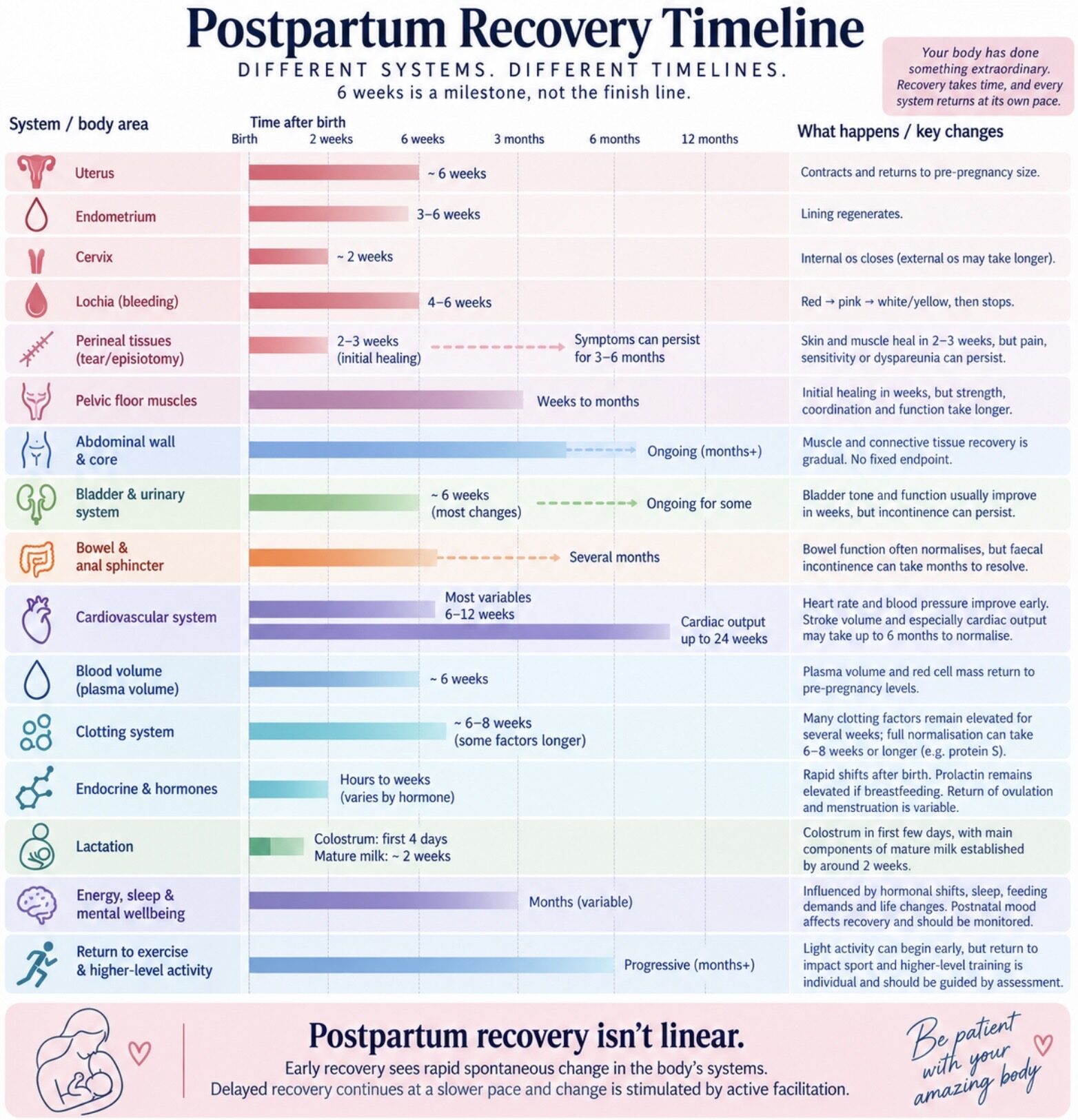
This graph was created from Wray S, Prendergast C, et al., Glob Libr Women’s Med ISSN: 1756-2228; DOI 10.3843/GLOWM.415293 https://www.glowm.com/article/heading/vol-15–the-puerperium–physiology-of-the-puerperium-and-lactation/id/415293#
What does this mean for your postpartum care?
The American College of Obstetricians and Gynaecologists has made a clear and comprehensive list of recommendations on postpartum care. Scroll down to see the full list of recommendations.
These are three points taken from the list of recommendations:
- Postpartum care is an ongoing process that doesn’t necessarily stop at 6 weeks and is tailored to support the woman’s individual needs
- Women who had complicated pregnancies or chronic medical conditions require care that’s ongoing and coordinated between health care professionals
- Postpartum care considers the whole woman – physical, psychological, and social. Every aspect of her well-being matters.
Healing is not the same as returning to function.
This is particularly helpful to understand.
A tissue can be healed without the body being fully restored to its previous level of function.
For example, a perineal wound can have healed, but the pelvic floor may not have regained its previous strength and coordination, or pain may be persisting.
Similarly, a mom’s abdominal wall and c-section scar may have healed well, but she still feels disconnected and unable to regain strength.
This is why “healed” and “back to normal” aren’t necessarily the same thing.
Healing describes what is happening to the tissues.
Function describes what your body can actually do.
Give your body time.
Pay attention to what it is telling you.
And if something isn’t working as it should, don’t assume you simply have to live with it because you’ve had a baby.
The American College of Obstetricians and Gynaecologists makes the following recommendations and conclusions:
• To optimize the health of women and infants, postpartum care should become an ongoing process, rather than a single encounter,
with services and support tailored to each woman’s individual needs.
• Anticipatory guidance should begin during pregnancy with development of a postpartum care plan that addresses the transition to
parenthood and well woman care.
• Prenatal discussions should include the woman’s reproductive life plans, including desire for and timing of any future pregnancies.
A woman’s future pregnancy intentions provide a context for shared decision-making regarding contraceptive options.
• All women should ideally have contact with a maternal care provider within the first 3 weeks postpartum. This initial assessment
should be followed up with ongoing care as needed, concluding with a comprehensive postpartum visit no later than 12 weeks
after birth.
• The timing of the comprehensive postpartum visit should be individualized and woman centred.
• The comprehensive postpartum visit should include a full assessment of physical, social, and psychological well-being.
• Women with pregnancies complicated by preterm birth, gestational diabetes, or hypertensive disorders of pregnancy should be
counselled that these disorders are associated with a higher lifetime risk of maternal cardiometabolic disease.
• Women with chronic medical conditions, such as hypertensive disorders, obesity, diabetes, thyroid disorders, renal disease, mood
disorders, and substance use disorders, should be counselled regarding the importance of timely follow-up with their obstetrician–
gynaecologists or primary care providers for ongoing coordination of care.
• For a woman who has experienced a miscarriage, stillbirth, or neonatal death, it is essential to ensure follow-up with an
obstetrician–gynaecologist or other obstetric care provider.
• Optimizing care and support for postpartum families will require policy changes. Changes in the scope of postpartum care should
be facilitated by reimbursement policies that support postpartum care as an ongoing process, rather than an isolated visit.
- American College of Obstetricians and Gynecologists. (2018). Optimizing Postpartum Care. Committee Opinion No. 736. Obstetrics & Gynecology, 131(5), e140–e150. doi:10.1097/AOG.0000000000002633. https://www.acog.org/clinical/clinical-guidance/committee-opinion/articles/2018/05/optimizing-postpartum-care
- American College of Obstetricians and Gynecologists. (2022). My Postpartum Care Checklist. Reviewed 2025. https://www.acog.org/womens-health/health-tools/my-postpartum-care-checklist
- Alexandra C. Nutaitis, Christina Lewicky-Gaupp, Katie Propst, Lisa C. Hickman, Jocelyn Stairs, Lindsey A. Burnett “Peripartum Pelvic Floor Disorders” Current Obstetrics and Gynecology Reports (2026) 15:8, https://doi.org/10.1007/s13669-026-00459-z


